Saturday, November 28, 2015

The self sufficient collector

I learned a lesson today about being a self sufficient collector.  For those unfamiliar with the term, it is using your knowledge and experience in a hobby to buy and sell so that you can buy to keep.  A good example is picking up a nice condition Hamilton 992b for $50 and flipping it for $200.  Take that $150 profit and follow the same process a few more times then buy a watch to keep.

I managed to follow this process to buy an Omega Aqua Terra 150M co-axial chronometer chronograph.  I had to find extra links for it but I could never have done it without the buy sell buy keep process.  I have done this to get a few of my better watches.  It is the best way to collect on a limited budget.

So as to the lesson, I was trying told to move my sales posts on watchuseek to the dealer sales forum instead of the private sellers forum.  Mind you I have been a member 6 years and post in other threads other than just selling.  In fact a nice reader joined the forum just because of my Joseph Johnson post here.  But they deem it necessary to make me post in a dealer sales forum because their opinion is that I am doing it as a business.

I follow the rules and a mod takes it to form an opinion about who I am.  The move is to allow people who only occasionally sell to be more visible.  This is a laugh as many buyers use WatchRecon to find the watches posted than paging through their sales forum.  It gives you the ability to see sales posts on multiple forums.  Great sight, check it out, just Google WatchRecon.

So I have been labeled a dealer.  I have been told my post quality is not there to make them think that I am there for anything other than selling and I use the forum to essentially mine for information. I'm sorry but any minor information the members have given was just an addition to what I already knew.  25+ years of collecting gives you a rather good knowledge base.

Most of my posts here have been a copy of what I posted on the forum.  You can judge for yourself if I am mining for info for just selling for profit.  So I will be trying the TimeZone forum for a bit.  Many ex forum members with dissolutions about how the forum was has moved there.  Ever since Earnie sold thing have gone less as well as they were and that was called "progress".  Whatever.....

Tuesday, November 17, 2015

Hacking 1850 Joseph Johnson Liverpool

A local coin shop had this one on hand. It came in with 2 other watches. The others are ok but not remarkable in rarity. A 15 jewel HC US Watch Co Waltham 18s lever set and a 23 jewel 16s lever set Waltham on an OF case. Those were a no brainer purchase based on his pricing. The 3rd watch I had to think over. Not a cheap watch by a reasonable collectors standard and I don't plop cash down randomly. 

I tried to do as much research as possible on this one. It is a 18k fully jeweled Joseph Johnson from 1850 (per the hallmarks). When I first looked at it my biggest concern was the potential that it needed repair. The missing second hand was obvious but the function of the movement was priority. A gentle rock and watching the lever and escapement gave me my answer. The wheel turned and the lever engaged. Balance swings freely so no issue there. He had no key and neither did I so the mainspring condition was a mystery. He named his price and based on the gold content and weight we both know he was under scrap.

He explained that he knew it was too nice to scrap out and would rather make a little profit then destroy it for just a bit more money. This the the kind of coin shop I like the most! So I left without it because I needed to research. I found some posts on NAWCC and auctions and think there are some gaps in info out there. 

Joseph Johnson of Liverpool started watchmaking in 1895 around the age of 15. He apparently only lived to about 45. He, in my opinion, made some very nice movements. Most seem to be fully jeweled with Liverpool windows. By the fact his children had the same name so good chance is that they carried on with the company up until the early 1860's.

My example even has a jeweled English lever. So my estimates are 16 to 17 jewels. This one, along with many, has diamond endstones. The balances on the ones I have seen vary. I have seen solid gold, steel, bimetallic with a blued steel center, a uncut bimetallic with screws, and then mine which is a cut bimetallic with screws. So there appear to be 5 different balances in use over 60 years and they almost seem to follow a natural progression in technology. 

All are gilt, fusee, and full plate movements. The click and pawl as seen on mine seems to only be used sparingly. One feature mine has that I think many miss looking at these is the "hack" lever. These are hacking pocket watches made prior to 1860 and I would say this feature was put on the better end of their movements. 

A quick search of ebay shows orphaned and parts movements that have this function. We know that most of these movements are only in this state after their cases were scrapped. Most likely these were heavy 18k as it appears that when Johnson cased in gold it was 18k.

Joseph Johnson watches were used on the American railroads prior to the establishment of the standards and in a time that English watch making was at its best. You can see some of the elements that correspond to what the American watch industry would put into the iconic American railroads watches. Full jewel, split bimetallic screwed balance, and lever escapement. You also see the diamond endstones make their way into the higher end 21 and up American watches. 

So without further babbling by me here are the first group I took after just getting it.


Picture of the hack lever at 5. Another is further down as well.


These are after I got it home and cleaned and oiled it. The case came up very nice. I did manage to rummage up a second hand of the right length but the pivot hole was too small. I used my staking set to broach out the pivot hole but it came up jut a hair too big so I crimped it back down just a bit. I would love to get a matching hand set for the watch but at the moment that is just a pipe dream.


I used a polishing cloth and and cape cod on the case
.

My First Vacheron

I was set up at a local antique show and managed to snag this off another antique dealer. The dial does not suffer from chips or cracks which is great considering it looks like it saw lots of use.

Serial dates it between 1915 and 1920. The watch is a contract watch for the US Army Corps of Engineers. The contract ran from 1918 to 1920 for 5000 watches. From what I have found on line they delivered under 4000 of them and the large majority was for the single button chronograph.

As far as I can find the watch is 100% original and unmodified. I am interested in finding out more about the number on the back. I feel that there is some discrepancy in how the watches are numbered. While I understand there was a 5000 watch contract with V&C for Corps of Engineer watches there appears to be a letter requesting "half chronometer" watches from V&C in the total of 2000 as well. The letter states that they are to be numbered 10,351 up to 12,350. If the numbers on the cases on the image below are scrutinized there are cases marked with the same "property of Corps of Engineers USA" between 10,986 to 12,51X that are not V&C time only watches.

Would the US Army request multiple companies to use the same numbers on multiple watches of multiple makes and functions? If these numbers were used to record the issue of a watch then you could have 5+ people with the same watch number. This seems very poorly recorded and tracked on the part of the US Army. 

The watch needed some external and internal gentle cleaning. Ticking away happily on my desk.


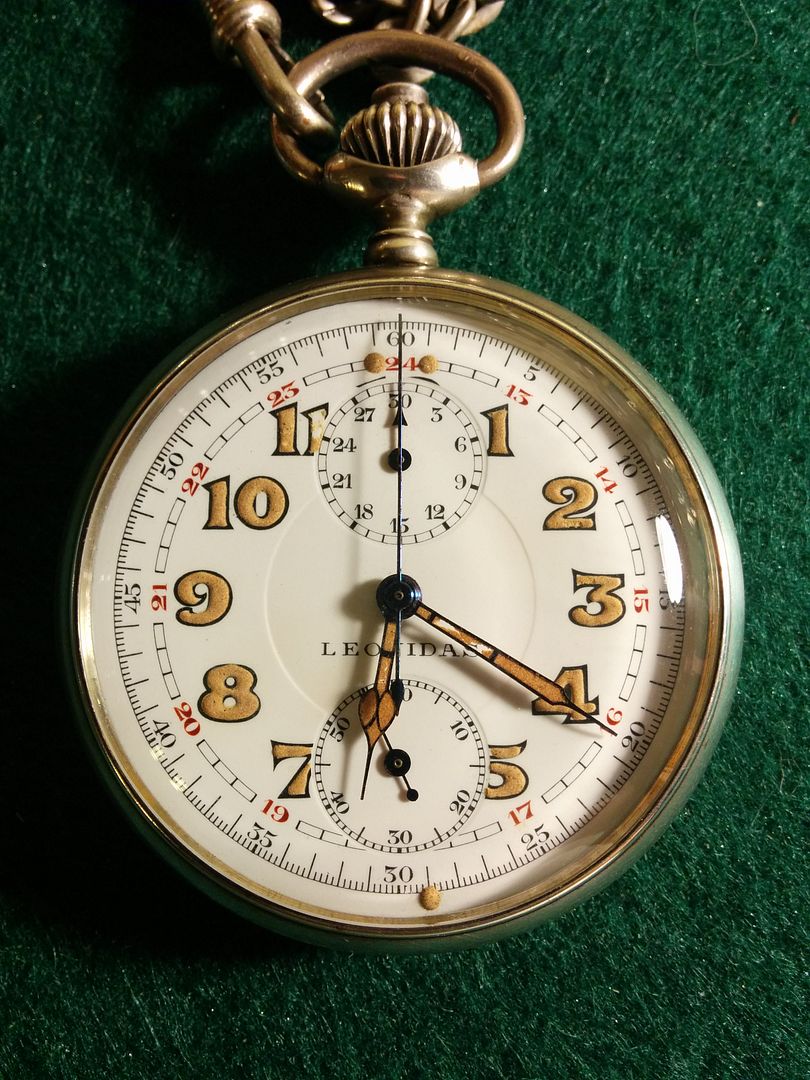
My recent hunt results... Leonidas Kriegsmarine and more

It again has been some time that I have been a stranger here. Despite the lack of posts there has been no lack in the bounty in recent months. The coin shop source for me has been rather good still. The last thing I posted about was an 1850 18K Joseph Johnson on Aug 2. Seems longer ago than it is I guess. I sold that to finally get something I wanted so badly, an Omega AT M150 Coaxial Chrono.

Anyways I kept going back and the dealer would surprise me rather often. A Hamilton 992B in stainless case $50 comes to mind. Then a 992E with a Gail Borden in near mint and some generic 15 jewel HC Elgin all for $200. 1878 18s 15 jewel Elgin in a coin silver heavy case was $20 but needs a crystal. So far he has been the best source I have ever had. I did pick up a Hamilton 921 at a antique show for $120 though but not a screaming deal.

So on to what the title says.... I was in his shop today and before I even had to ask he was getting a couple pf watches off his back counter. First up was a rather basic 6 or 8 size Elgin HC watch. My first though...oh no is this it. Then he puts this watch down face down. Obviously the first thing that I see is the Eagle all bold and not ground down. I turn it over and nice and bold Leonidas is looking at me square in the eyes. The crack in the crystal is barely registering as I am eyeing up the condition. Thick original lume on the numbers. Most of it still in the hands as well. The blue steel not showing a single spot of rust. Does it get better? Does it run???

I give the watch a light movement of the wrist and it ticks for a few seconds and stops. Well the balance may be good then. I open the back and there is this butiful, but dirty Cal 45 movement. No rust still so there is hope. I get the balance to swing again, check the chrono function. As I am looking at it I finally notice the chain and coin. I confirm with him that the two came in together...yep. What a huge fob! Seems impractical but rather fitting. The German war machine was known for the grand scale that they liked to put on a dress show...what better than a big 1768 silver Thaler. 

So now come the question...how much. I am running through my head how to come up with hundreds to pay for it. He gives me a price for both and lets just say I could not get the check book out fast enough.  

So I got the poor thing home and went right to my bench, that I finally moved in the house and set up. I spent the next couple of hours cleaning, pegging out holes, and oiling the pivots as it went back together. There is just something about hearing a watch start to tick after you put the balance back in. That sense that you did something right and the watch is thanking you. Sadly I did not have a crystal for it so I will have to go bug the watchmaker I use to frequent to put a glass one in for me. The broken one is plastic and I don't have one the right size for it. 

And now what we all want....Pics 


I got my watchmaker to fit a glass crystal on the watch.  Below is how the finished watch looks with the new glass.

Monday, October 13, 2014

Lots of Blue Hampden

One of my recent purchases. I try and stay away from pocket watches but I keep getting sucked back into them. I tend to have a weakness for Hampdens as well. Some rather uncommon movements out there and people seem to never notice them.

This is a 16s 17j grade 240 made for W. J. Johnson in 1908. 1 run of 1000 in that year only is the total production. So far this is the only watch where steel parts being blued to this extent I have seen. Screws, escapement wheel, pallet fork, regulator, balance wheel arms, hairspring stud, and pinions have all been blued. If you look close at the tops of the train pinions, they are blue as well.


Click this bar to view the original image of 885x1024px.


A Different Auction - The Longines Mainliner and 14K Omega Seamaster 550

We typically hit estate sales and the such on weekends looking for things to put in the antique malls, and watches as usual. We had just finished going through a sale and there was a estate auction no less then 3 blocks away. We had already resigned ourselves to not bothering but in the auction listing there was a 3.15 cttw antique diamond ring with appraisal. With the only page I could see on line of the appraisal it showed 5 stones and 4 were .05 ct. The math in my head says that is a .20 cttw so the main stone is like a 2.95 ct. That is huge and well worth a chance. Called up my diamond buyer and was told that depending on the 3 c's I could get $45k or so for it. 

We take our haul back home and then hot foot it back to the auction. I finally get a chance to see the ring and the appraisal and something does not sit right with me. Maybe I am bad with math but when the report says that the main stone is a 2.3 ct and the 4 side stones are .05 each....to me that is 2.5 cttw. What the :( So the paperwork may be wrong on that but they said they had a jeweler look over everything and they said all the cut color and clarity are right. Well with a K color and an I1 clarity I could only get $4.5k for it. I figured I would register anyway just in case it went for cheap...then the guy in front of me in line getting a number turned out to be a family member and the executor of the estate.

I so hate auctions where all the family member go bidding stuff up to increase what they get directly out of the sales of the items. I call this blatant shill bidding and most honest auction houses I know don't allow this kind of situation. So I have the number but am at the "screw this crooked setup I am out of here" feeling and get ready to leave and then I spot an Omega pox on a table about 40 feet away...I make a b line to that table. In a carboard flat there is a JJ (modern quartz) watch in box, a Elgin pocket watch, a ladies Bulova they called 14K (was GF), a mens Longines, the Omega box with an Omega Seamaster in it, and a few other random watches (junk).

So while I was waiting for them to finally get to the box of watches they were doing choice out of other boxes on the tables of jewelry in flats as well. I was bored but made the best of it by buying silver for under scrap price. Low and behold in one of those flats was a brass metal watch box...I open it up and find some beat up worn down Clinton in an amazing Longines box. There was little interest in the watch box so I snagged it for $15 with a hope it went to the Longines I saw in the watch box.

The time finally came and I could see some others eyeing up the watches. They did choice again. The issue with choice is you never know if the person you are bidding against is after the same item. Being the Omega and Longines were in the running I refused to not be the one who did not win. My wife knows that I will try and never over pay but when I finally nailed the first bid to $210 she was a bit concerned. Snapped up the Omega and it started again....she kept saying "You do know most of these people bidding are most likely after the pocket watch." It did nag me in the back of my head that this could be true and they are after a 15 jewel Elgin because people over pay for stuff like that at auctions here. That said I still went ahead again...landed at $175 and snapped up the Longines. AT this point I was done bidding. The pocket watch went for $85 and by this time the table looked like a ghost town because the Omega was gone. 

As for that big diamond...that came up while my wife was bidding on choice for jewelry out of a box. She managed to get more silver and a 18K bar pin for $5 :) The main auctioneer's hammer fell on $5,800 for the big diamond and apparently it had a $5000 reserve to begin with. So the item we went back for was not worth it to us and in the end I got these two beauties.

The Longines box did indeed belong to the watch and confirmed it later by the serial on the price tag matching the movement serial. It is a 1947 Mainliner with a replacement leather strap in good working order. I went and got a new black leather strap for it as the old one was kind of grubby and not original anyways.

The Omega is a 1970's automatic Seamaster Deville with warranty book and paper slip for service center locations. I need to take it to the watchmaker for a new Omega crystal as the original one is cracked around the edge and the bezel is popping up because of it. We have yet to find out what the movement is. Based on the back engraving, the slight wave to the case and the flex I could feel on the back as I was trying to get the bezel to stay snapped down, we suspect the watch is 14K. The auction house never got into the watch because they don't know how a snap stem works and it is a open through the crystal. May explain why the bezel was not sitting right and the crystal is cracked, someone playing watchmaker without the right tools. Still not a difficult fix. :) 

And without further ado.....PICS!!!!